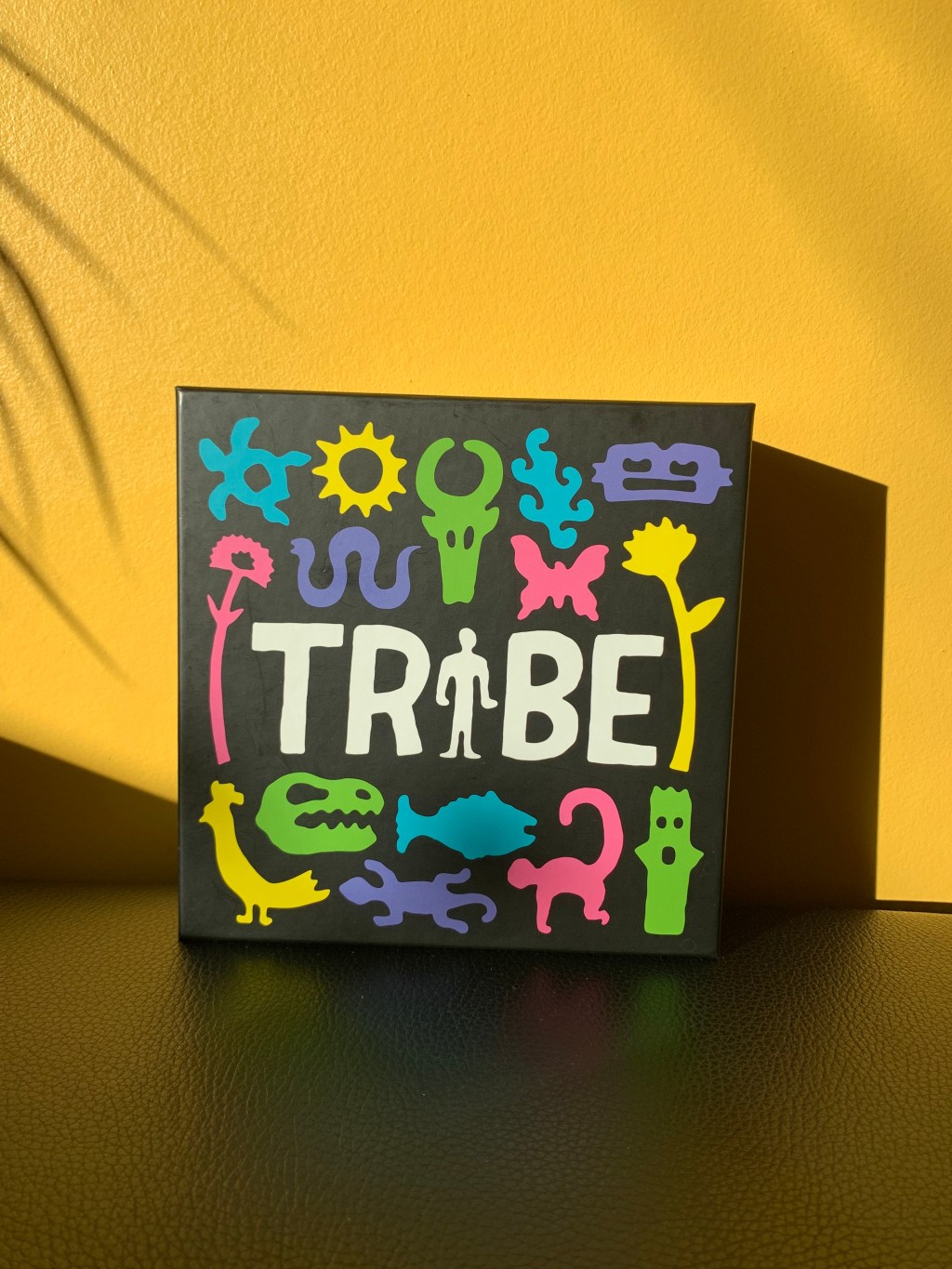
At Spellenspektakel Utrecht 2025, I came across the Quality Beast stand, where they were exhibiting their games, including Tribe.
Travel through time and enter a world where you can let human characteristics flourish.
Beoordeling
| Overall | 8.5 |
| Story | 7 |
| Game system | 10 |
| Design & art | 9 |
| Replayability | 9 |
Tribe is an entertaining puzzle game for 2 to 5 players aged 8 and up. It has a manageable playing time of about 30 minutes. You’d better have a steady hand to place all those ornaments perfectly!
Story
You will travel through time to let human characteristics flourish. Some people will develop the same characteristics, but each person will also be unique. Use the beautiful ornaments to discover and develop human characteristics. What could humanity look like? You hold the future of the tribe in your hands.
Do you want to collect the most splendour points? Then be very alert and observe carefully. Be nimble to place as many ornaments as possible on the figures in a creative way.
Objective: Try to collect splendour points by finding as many group characteristics as possible in human figures with common features, or by finding individual characteristics in a human figure with distinctive features. Place the ornaments on the people in the tribe carefully. The player who collects the most splendour points is the winner. Please note: unintended movements or a ponytail can throw a spanner in the works.
Rules of the game
A turn consists of the following steps:
- Roll the dice and choose
- Place an ornament
- Search for characteristics and collect splendour points
Roll the dice and choose
As the starting player, you choose a regular ornament instead of rolling the dice. From then on, the dice is rolled at the beginning of each turn.
If the previous player has placed a regular ornament and you roll a:
- eye: Choose a regular ornament with the same colour or shape as the ornament placed by the previous player.
- hand: Choose a regular ornament with a different shape and colour than the ornament placed by the previous player.
- ear: Choose one random folklore ornament.
If the previous player has placed a folklore ornament and you roll a:
- eye: Choose a regular ornament with the same colour or shape as the ornament placed by the previous player.
- hand: Choose a regular ornament with a different shape and colour than the ornament placed by the previous player.
- ear: Choose one random folklore ornament, regardless of colour or shape.
Placing ornaments
Place the ornament on a human figure of your choice. Follow these rules:
- The ornament must not touch the table or pedestal.
- Your hand must not touch any of the ornaments already in place.
- Ornaments of the same colour or shape must not touch each other. This applies to both regular and folklore ornaments.
- If you do not follow these rules, or if an ornament that has already been placed falls while you are placing your ornament, you lose splendour points according to the steps below.
- Return one splendour point to the supply for each colour of the fallen ornaments.
- Remove all fallen ornaments; these are out of the game.
- Place your chosen ornament on the figure from which you dropped ornaments.
- You will not receive any points for creating properties this turn.
Searching for properties and collecting splendour points
After placing your ornament, you search for properties to collect splendour points. You do this by searching for sets of ornaments on the human figures. There are two different types of traits: group traits and individual traits. You receive splendour points when you determine that you have created a trait by placing your ornament during your turn.
- Group characteristics: A group characteristic is a set of common ornaments distributed across different human figures. There are three types of sets, based on three different types: colour, shape and folklore elements. The number of splendour points you receive depends on the number of figures across which these sets are distributed.
- Colour: Human figures with ornaments of the same colour.
- 3 figures: 1 point
- 5 figures: 2 points
- Shape: Human figures with ornaments of the same shape.
- 3 figures: 1 point
- 5 figures: 2 points
- Folklore ornaments: Human figures with folklore ornaments.
- 3 figures: 1 point
- 5 figures: 2 points
- Colour: Human figures with ornaments of the same colour.
- Individual characteristics: This is a set of common ornaments on one human figure. There are four types of different sets: colour, shape, folklore ornaments and all colours.
- Colour: Ornaments of the same colour on 1 figure
- 3 ornaments: 1 point
- 5 ornaments: 2 points
- Shape: ornaments of the same shape on 1 figure
- 3 ornaments: 1 point
- 5 ornaments: 2 points
- Folklore ornaments: folklore ornaments on 1 figure.
- 3 folklore ornaments: 1 point
- 5 folklore ornaments: 2 points
- 1 ornament of each colour:
- 5 ornaments: 2 points
- Colour: Ornaments of the same colour on 1 figure
End of the game
The game ends when one of the following situations occurs
- The folklore ornaments are all out of stock.
- The ornaments are all out of stock.
- There are no more ornaments available that can be placed according to the rules.
Then you add up all the splendour points you have collected. The player who has collected the most splendour points is the winner. If a player has no splendour points left during the game, they are eliminated from the game.
Contents and design
The game pieces are of very good quality and the design is beautifully finished: rather sober, but very attractive and artistic. There are three sets of basic rules in the rulebook and three sets of advanced rules, so that the level of difficulty can be gradually increased. The game is well designed in terms of game dynamics and contains sufficient tactics, so that it is not just a building game.
Also in the box
• 3x rulebook with basic rules (ENG/NL/DE)
• 3x rulebook with advanced rules ( ENG/NL/DE)
• 5x human figures
• 5x pedestals
• 15x folklore ornaments (3x 5 colours)
• 30x regular ornaments (6x 5 colours)
• 1x dice
• 25x splendour points
Conclusion
Tribe is a well-designed puzzle and building game. It is well balanced and the rules are explained very clearly in the rulebook. However, it may be useful to keep the book at hand when playing for the first time.
The rules are more complex than most puzzle-building games I have played. Nevertheless, it is a pleasure to play because it is not just about placing ornaments, but also about tactical choices. So it goes beyond what we are used to.
After playing twice, however, everything becomes clear and the game is easy to explain, even to younger children in the group. Some people may be put off by the fact that you have to observe and make choices on several fronts, but for advanced board game players, this is actually very enjoyable. The fact that it is a short and entertaining game is an added bonus.
More info: https://qualitybeastug.myshopify.com/
Text and photography: Esmeralda Wolf
