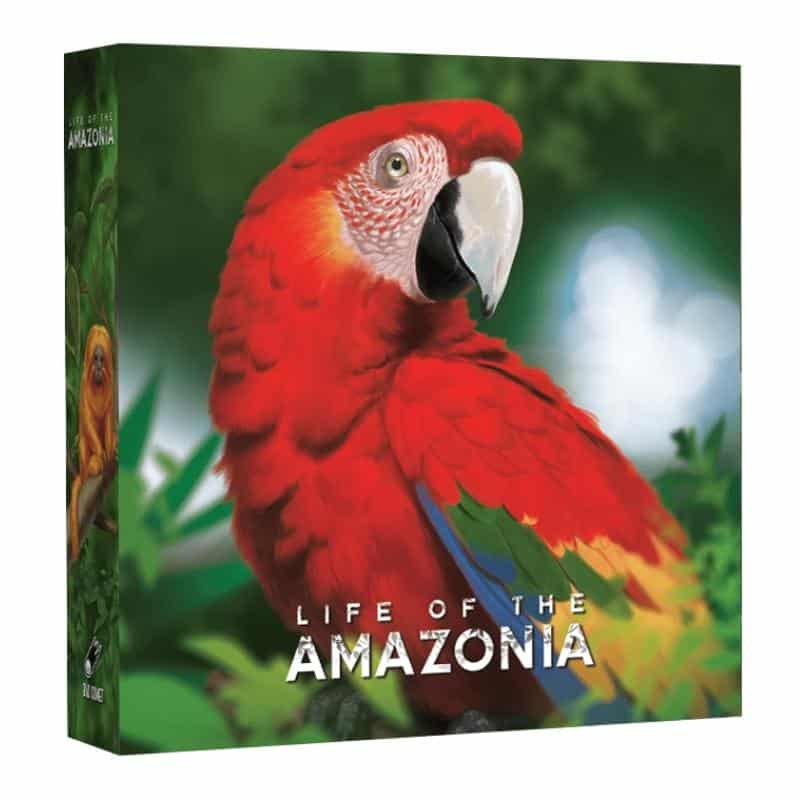
Life of the Amazonia is a game that takes you deep into the Amazon rainforest, where you’ll encounter the immense diversity of plants, insects, and animals. It combines elements of both a pattern builder and a bag builder. The game can be played solo or with up to four players. For nature lovers who enjoy seeing their own corner of the Amazon flourish, this is an excellent choice!
Rating
| Overall | 9 |
| Story | 7 |
| Game system | 10 |
| Disign and Art | 8 |
| Replayability | 9 |
The Story
The Amazon region is home to the largest collection of plant and animal species in the world. One in every five known species of plants and animals lives there. In Life of the Amazonia, you start your own conservation project to help restore the rainforest by planting trees and plants so that wildlife can thrive.
Game Rules
Some general components:
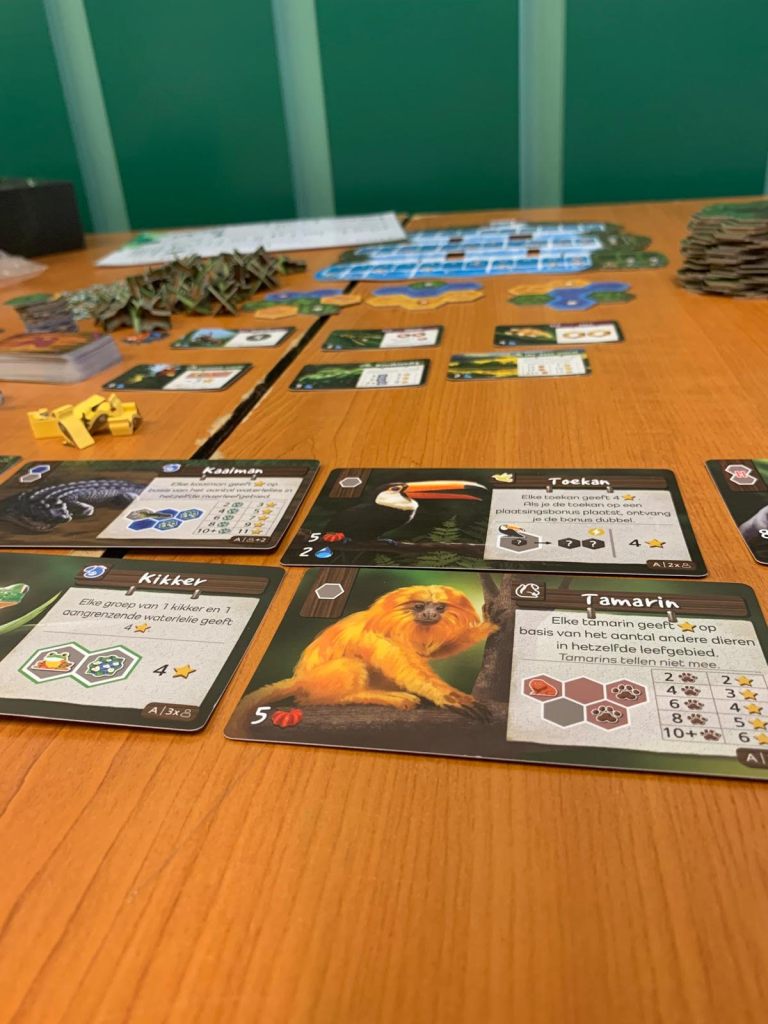
• Animals: Animals are one of the three lifeforms in the game. There are eight basic animal species (the number per species depends on the number of players). Each species has four scoring cards; you choose one per species at the start of the game. Each shows how to earn points with that species at the end of the game.
• Terrain tiles: Each tarrain tile consists of seven hexagons: forest, water, or swamp. Some hexes provide bonuses when you place a lifeform (tree, flower, or animal) on them. Each time you buy a terrain tile, you move forward on the tile track, earning bonuses and points. Single hex tiles (forest, water, swamp) can be used to fill gaps or cover other tiles.
• Trees: One of the three lifeforms. Always placed on forest hexes. Planting trees moves you up the tree track, earning bonuses and points. Trees are sometimes required to score animal cards.
• Water Flowers: Another lifeform, placed on water hexes. Planting them advances your marker on the water-flower track, earning bonuses and points. Sometimes required for scoring certain animal cards.
• Seeds: Earned as bonuses. Seeds act as wildcards worth one of any resource.
• Resources: There are four types:leaves, water, fruit and gold. With values ranging from 1 to 4. Gold is used to buy other resources. Leaves, water, and fruit are used to buy trees, flowers, and animals. Water is also used to purchase nature cards.
• Nature Cards: Two types,insect cards and landscape cards, both bought with water. They provide bonuses or extra scoring opportunities.
• Waterfall Board: Displays the tile, tree, and flower tracks, plus the backpack track, which determines how many resources you can carry over to your next turn.
Gameplay
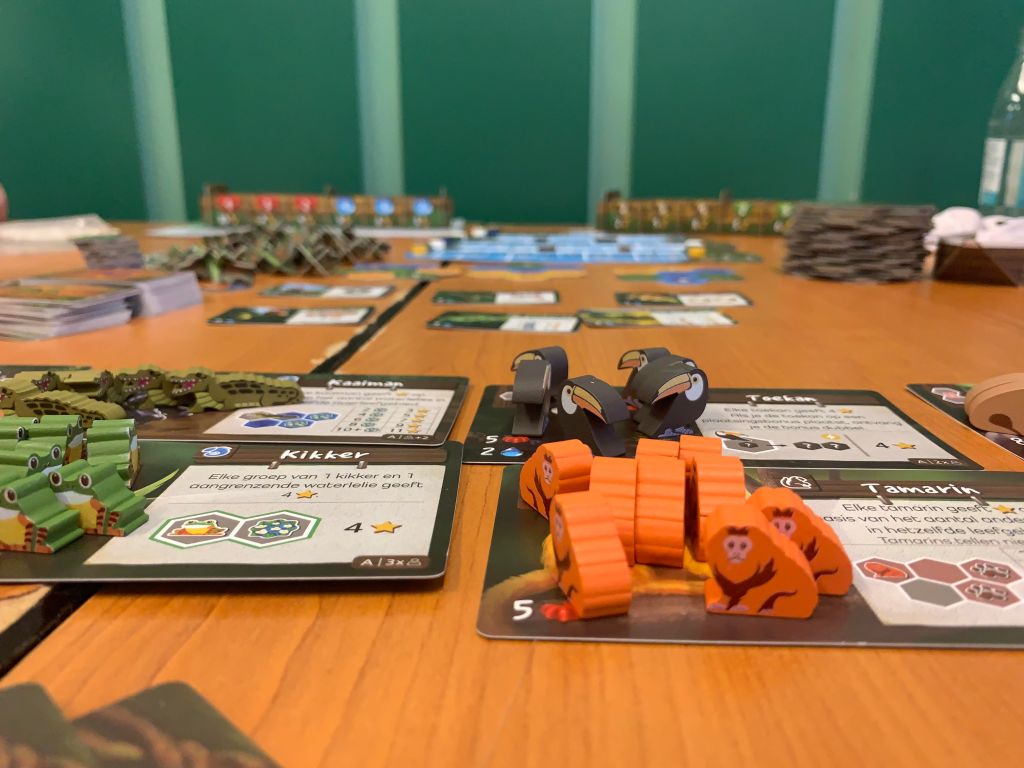
On a player’s turn, they draw five resource tokens from their bag. Using these (plus any carried over from the previous round), they may perform as many actions as they can afford, in any order. “Change” is not given. Used and newly purchased tokens go into your boat. When your bag is empty, return all tokens from your boat to refill it.
Possible Actions
- Buy a Resource Token: Use gold to buy new resource tokens. Place them in your boat for future use.
- Place a terrain tile: Move one space up the tile track and pay the leaf cost shown. Tiles become more expensive as you buy more. Choose from the three available and place it in your jungle.
- Plant a Tree: Move up one space on the tree track and pay the cost in leaves. Trees also increase in price as you plant more. Place it on a forest hex.
- Plant a Water Flower: Move up one space on the flower track and pay the water cost. Place it on a water hex.
- Place an Animal: Choose a basic animal, pay its resource cost, and place it following placement conditions. Your unique animal can be placed for free. Small animals occupy one hex; large ones cover two.
- Buy a Nature Card: Use water to purchase an insect or landscape card. Insect cards take effect immediately, giving bonuses or actions. Landscape cards are kept for end-game scoring (max. 4 per player).
- Expand Your Backpack: Pay water to increase your backpack capacity (from 1 to a maximum of 3 tokens between rounds).
- Buy a Bonus: The waterfall board shows four available bonuses: gain a seed, buy a single hex, compost a resource token, or relocate a lifeform in your jungle.
When you have used or chosen to save your remaining resources, your turn ends. The next player clockwise takes their turn. You may already draw your next five tokens to plan ahead.
The game ends once five of the eight basic animal species are depleted. The player who purchased the final species earns a 5-point bonus token. All other players take one final turn, then scores are tallied. The player with the highest ecological score wins.
Components and Design
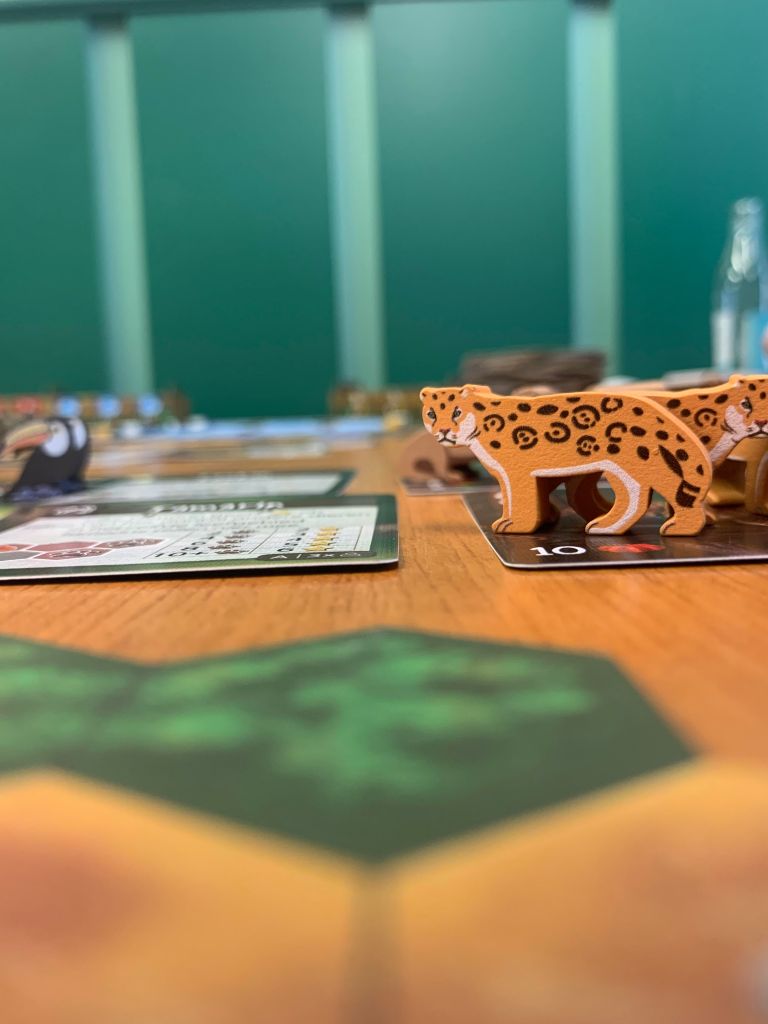
The game’s artwork is beautifully crafted, from the biome tiles to the wooden animal pieces and cards. The wooden animal tokens are particularly stunning and make the game feel alive.
However, there are a few minor downsides: The waterfall board is made of thin cardboard, which feels fragile since you assemble and disassemble it often. The trees and water lilies are cardboard rather than wood, which feels inconsistent with the otherwise premium components. (Yes, there’s an upgrade kit available, but it would have been nicer if this were part of the base game.)
Box Contents
Wooden animals:
• 5x jaguar
• 5x large otter
• 6x ara
• 6x crocodile
• 12x woodpecker
• 12x frog
• 12x tamarin
• 8x toucan
• 1x anteater
• 1x river Dolfin
• 1x anaconda
• 1x hoatzin
• 1x sloth
• 1x river turtle
• 1x iguana
• 1x armadillo
Resources:
• 8x water value 1
• 14x water value 2
• 12x water value 3
• 10x water value 4
• 12x gold value 1
• 20x golde value 2
• 12x gold value 3
• 8x gold value 4
• 8x leaves value 1
• 14x leaves value 2
• 12x leaves value 3
• 10x leaves value 4
• 16x player markers
• 4x resource bags
• 4x starting tiles
• 36x terrain tiles
• 21x special terrain tiles
• 42x trees
• 42x water lillies
• 16x seeds
• 5x complete tokens
• 1x end game token
• 4x boat
• 2x resource trays
• 1x waterfall board
• 8x automa tokens
• 1x score pad
• 1x rulebook
• 4x player aids
• 1x automa kaart
Cards:
• 16x base animal cards
• 8 x unique animal cards
• 48x insect cards
• 42x landscape cards
Conclusion
If you love strategy and bag-building mechanics, Life of the Amazonia is a masterpiece. It’s a perfect blend of resource management, pattern creation, and strategic planning. With over 60,000 possible combinations of animal cards and numerous strategic paths, its replayability easily deserves a 10/10.
The nature and wildlife theme is both relevant and inspiring, especially in this era of climate change. Even if you’re not particularly into environmental themes, the artwork and design make this a gem worth playing. And like many modern games, it includes a solo mode, which I consider a major plus.
Text en photography: Esmeralda Wolf
