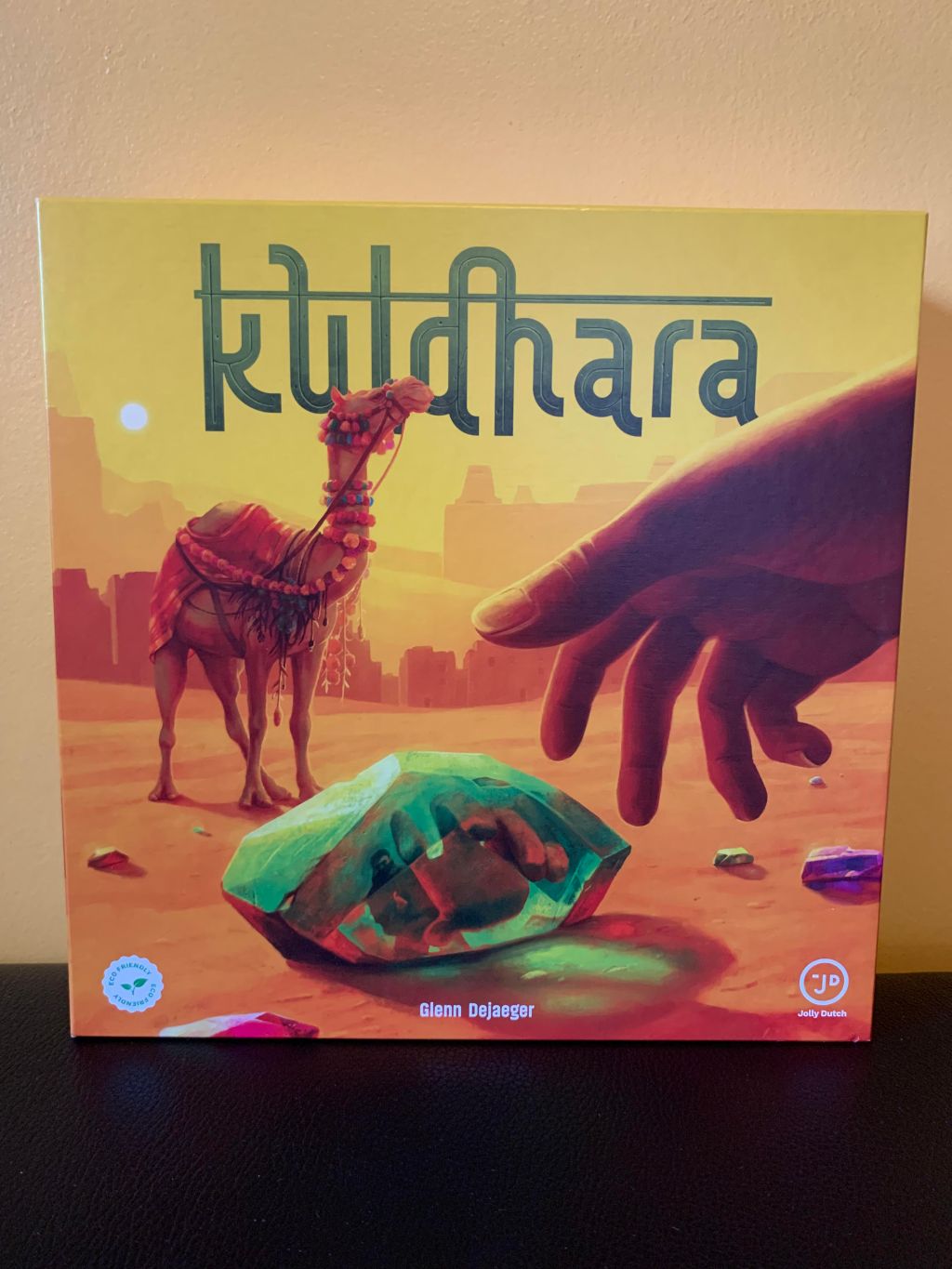
At Spellenspektakel Utrecht 2025, I had the pleasure of meeting Alexander Kneepkens, co-founder of Jolly Dutch. They proudly presented their new game, Kuldhara. If you would like to learn more about Jolly Dutch’s vision and values, you can read the interview here. It gives an overview of how Jolly Dutch was founded and how important the ecological aspect is to its founders. That is why I am delighted to be able to discuss this game.
Take on the role of a desert raider to obtain the lost gems from the ruins of Kuldhara and forge beautiful jewellery.
Beoordeling
| Overall | 9.5 |
| The story | 10 |
| Game system | 10 |
| Design & art | 9 |
| Replayability | 9 |
Kuldhara is an easily accessible puzzle family game for 1 to 4 players aged 8 and up. It has a manageable playing time of 30 minutes per player.
The story
Kuldhara was a village deep in the Thar Desert in Rajasthan, India. When the pressure from ruler Zalim Singh increased, the villagers decided to burn their village and disappear like shadows in the night. Zalim Singh was not only an inhumane leader who oppressed the inhabitants, but he also demanded the daughter of the village leader. The villagers did not want this to happen.
This happened 200 years ago, but the rumours and legends about curses and hidden gems still live on. Even now, Kuldhara remains a ghost town of abandoned houses and empty streets.
Step into the shoes of a fearless desert raider who wants to take his chance to retrieve gems from the ruins during the day to forge them into beautiful jewellery. But… even the desert raider knows he has to be gone before dark!
On this expedition, it is important to manage your water supply carefully in the sweltering heat of the desert. Every action costs water, so your actions are limited. Once you have the right gems, hurry back to your camp to forge them into valuable jewellery.
The goal is to forge as much valuable jewellery as possible before sunset!
Game rules
The game takes place over four phases of the day: morning, noon, afternoon and evening. When the evening phase is over, the game ends.
When a phase of the day begins, you start with a new water supply of 15 drops of water. Throughout the phase that has begun, you will use this water to take various steps. When everyone has used up their water or everyone has passed, the new phase of the day begins. Before that, a few actions are carried out:
The turntable is turned clockwise to the next position, the round marker moves forward one step, and everyone replenishes their water supply to 15 drops. The player with the starting player token goes first.
When it is your turn, you choose to play or pass.
Pass: You may pass when you do not wish to perform any more actions. If your water supply has dried up, you have no choice but to pass. If you pass before your water runs out, you drain your water supply to 0. You no longer participate in this phase of the day. Are you the first to pass in this phase of the day? Then you receive the starting player token so that you can be the first to start when the new part of the day begins.
Playing:
A turn consists of the following steps:
• Step 1: Perform 1 or 2 actions (mandatory): You can choose from 4 different actions: travel, dig up gems, unload gems, and make jewellery. Please note: each action costs you water, so it is important to keep an eye on your water supply. You are allowed to perform the same action twice during your turn.
- Travel: You can move your dromedary to a location of your choice on the board. You can pass multiple locations in one turn. Please note: each location you pass costs 1 extra water drop.
- Digging up gems: You can dig up one or two gems from the ruins where your dromedary is located and place them in your dromedary’s basket. Are there no more gems left? Then you are out of luck and will have to travel. The water cost per gem depends on its size.
Please note: your dromedary cannot simply carry tons of gems. There are 6 compartments in the basket. This means that you can carry, for example, 1 large gem (3 compartments), 1 medium gem (2 compartments) and 1 small gem (1 compartment). No more space? Then you urgently need to unload some gems. - Unloading gems: This action costs 1 water drop, regardless of how many gems you unload. Please note: this is only possible when you have arrived at your camp with your dromedary. There, every gem you unload must be placed on your work surface. This can be done on any hexagonal field that does not already have a stone on it.
Important: once the gems have been placed on your workspace, you cannot simply move them unless you use one of your five tool tokens (see step 2). So pay close attention. - Reserving a piece of jewellery: You may have a maximum of two reserved pieces of jewellery on your board at any one time. Important to note: when the game ends and you have not yet been able to finish the reserved jewellery, these values count as minus points in the scoring. Reserving a piece of jewellery always costs 1 water drop. You can reserve a piece of jewellery by choosing a visible jewellery card from the board. You then place this on one of the two spaces at the top left of your workbench. You can also choose to draw the top three cards from a stack and choose whether you want to reserve one of these pieces of jewellery. If you do not wish to do so, return the drawn cards to the bottom of the stack
• Step 2: Using tools (optional):
You may hand in one or more tool tokens to make changes to your workbench. For each tool token used, you may make one adjustment. However, each tool token can only be used once during the entire game. Do you have one or more tokens left at the end of the game? Each token also counts as one point.
You can choose to make the following adjustments:
- Move: move the contents of a selected field to another empty field on your workbench.
- Swap: swap the contents of two selected fields.
- Change colour: change the contents of your field to a different colour from one of the ruins.
- Clear fields: remove the contents of up to 3 fields on your workbench.
- Refill water supply: receive 3 water drops to use in the action phase of your next turn.
• Making jewellery (optional)
You can make a piece of jewellery when you have arranged the gems on your workbench in the correct pattern. Each gem and protection tile must be placed on your workbench exactly as shown on the card. You may rotate and/or mirror the pattern. To make a piece of jewellery, use an open jewellery card on the board or one of your reserved pieces of jewellery on your workbench. Follow these steps:
- Mark the pattern on your workbench (for level 2 and 3 cards, you will also need protection tiles).
- Take the corresponding jewellery card and place it next to your workbench
- Take a protective tile: if your jewellery card indicates that you will receive a protective tile (top right), choose a protective tile in a colour of your choice. You must immediately place this protective tile on a field of your choice, an empty field or a field with a gemstone of the same colour, on your workbench. Place. This protective tile protects the gem throughout the game. You are never obliged to take a protective tile.
- Remove all gems from your workbench that are part of the jewellery you have made (except for the gems that are protected by a protective tile). The gems are returned to the supply at the ruins
You may create multiple pieces of jewellery in one turn, but you may only start on the second piece of jewellery once you have completed all the steps.
• Replenish jewellery cards (optional):
Replenish all jewellery cards on the game board from the draw pile.
Einde van het spel
When the last phase of the day, the evening, is complete, night falls on the ruins and peace returns.
This is the moment to count all the points. The scoring is clearly described in the rulebook. The player with the most points is the winner of the game.
Contents and design
The illustrations are by Nicholas Westgard and are very beautiful and detailed. In this game, Jolly Dutch has once again demonstrated its eye for quality game materials and detail.
The rulebook is very clear and contains sufficient examples to provide good support even for novice board game players.
There is a solo play mode in the rulebook.
Verder in de doos
• 1x Rulebook (ENG/NL)
• 50x gems in 5 colours
• 1x central board with turntable
• 4x workbench with turntable
• 41x protection tiles in 5 colours
• 4x dromedaries
• 8x game overview
• 20x tool tokens in 5 colours
• 4x water droplets
• 1x round marker
• 1x starting token
• 66x jewellery cards (3 levels)
• 4x starting jewellery cards
• 18x solo cards (2 types)
• 1x Khadan’s workbench (for solo mode)
Conclusion
Kuldhara takes us on a journey through an existing legend on which the creators have based their own game system. As with all Jolly Dutch games, extra attention has been paid to the ecological manufacturing process. They also collaborated on this game with Glen Dejaeger, the game’s creator, a Belgian IT specialist from Flemish Brabant.
It is nice to see that the story also reflects a piece of history; you can easily look this up on the internet 🙂
The game system is well developed. A strong element is the rotating workbenches, which help people who are less skilled at spatial orientation at first glance. This proves that consideration has also been given to inclusion within a section of the population.
The rules of the game are explained very clearly and include clear examples. It is certainly a successful family game that plays smoothly. The puzzle element is also well thought out and beautifully presented. Jolly Dutch also provides a solo play mode for Kuldhara, which is definitely an added value, at least in my opinion :-).
At Spellenspektakel Utrecht 2025, I had the opportunity to talk to Alexander Kneepkens about his vision for board game design in 2025. You can find this interview here or under the interviews section.
More info: //jollydutch.com/product/kuldhara/
Text & photography: Esmeralda Wolf
